What is an AI token? A plain explanation, with a token counter
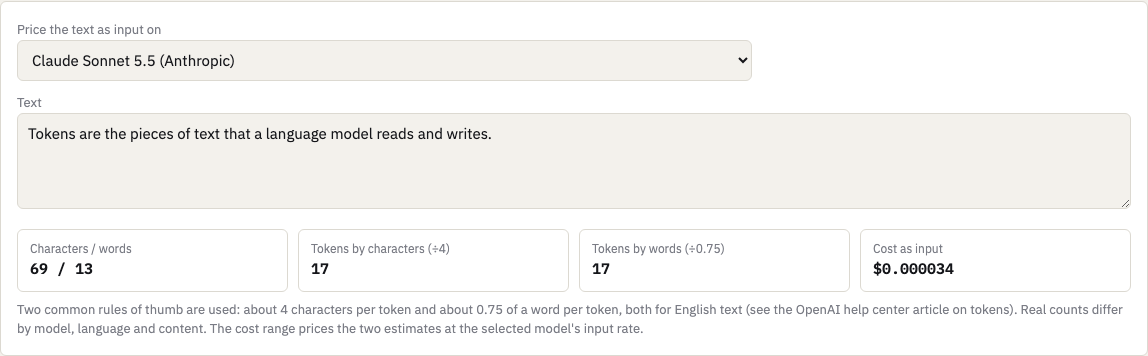
What is an AI token? It is the small piece of text a language model reads and writes, and the unit providers bill in. Paste any text below to estimate how many tokens it is and what it would cost as input. The count is an estimate based on common rules of thumb, because every model has its own tokenizer.
Estimate the tokens in your text
estimate only · text stays in your browserTwo common rules of thumb are used: about 4 characters per token and about 0.75 of a word per token, both for English text (see the OpenAI help center article on tokens). Real counts differ by model, language and content. The cost range prices the two estimates at the selected model's input rate.
What is an AI token? A plain definition
A language model does not read letters or whole sentences. Before it sees your text, a tokenizer cuts the text into pieces called tokens, and each piece is mapped to a number. A token can be a short common word, part of a longer word, a single digit, a punctuation mark or a space together with a word. So the answer to what is an AI token is simple: it is the unit of text the model works in.
Models produce text one token at a time, too. When a model answers, it picks the next token, then the next, until it stops. That is why providers talk about input tokens (what you send) and output tokens (what the model writes back), and why a token is also the natural unit for pricing, speed limits and context size.
The exact split depends on the tokenizer. A tokenizer might keep a common word such as "the" whole, while a rare word may be broken into several pieces. Nothing here tells you exactly where any given model will cut a given text, which is why this page only estimates.
AI tokens explained: why text does not map one to one
Tokens are built from frequent patterns in the data a tokenizer was trained on. Frequent English words tend to be single tokens. Names, product codes, URLs, long compound words and many non-English scripts are cut into more pieces. Code can be expensive too, because symbols, indentation and unusual identifiers each take tokens.
Tokens are not an exact science across vendors. Anthropic's tokenizer and OpenAI's tokenizers are different, so the same paragraph can have different counts on each. Our own pricing calculator mentions that one million tokens is roughly 750,000 English words on older tokenizers and about 555,000 on Anthropic's current one, which shows how much the ratio can move.
How many tokens in a word? Worked examples
The table shows the two estimates for five pieces of text. Copy any row, or press the button to load it into the estimator above. The numbers are rounded to whole tokens and are estimates, not counts from a real tokenizer.
| Text | Characters | Words | Tokens (chars ÷ 4) | Tokens (words ÷ 0.75) | Try it |
|---|---|---|---|---|---|
Hello | 5 | 1 | 1 | 1 | |
The quick brown fox jumps over the lazy dog. | 44 | 9 | 11 | 12 | |
Tokens are the pieces of text that a language model reads and writes. | 69 | 13 | 17 | 17 | |
print("hello world") | 20 | 2 | 5 | 3 | |
A short email of about forty words: Hi Sam, thanks for the call this morning. I have attached the draft agreement and the pricing sheet we discussed. Please read both before Friday and send me any questions. If everything looks right, we can sign next week. Best, Alex. | 269 | 48 | 67 | 64 |
A single word such as "Hello" lands near one token on either method. A full sentence of nine words comes out near eleven or twelve tokens. The rule of thumb that 100 tokens is about 75 words follows from the 0.75 figure, so 1,000 tokens is about 750 words and a 1,000-character paragraph is about 250 tokens. The two methods disagree by a few tokens on short text and drift apart on code or unusual vocabulary.
Tokens vs words vs characters
Words are what people count, characters are what a text box counts, and tokens are what a model counts. For English prose the three move together, which is why the rules of thumb work: roughly 4 characters per token and roughly three quarters of a word per token. For anything else they come apart. A line of Python, a long URL or a paragraph in another language can use well over one token per short word.
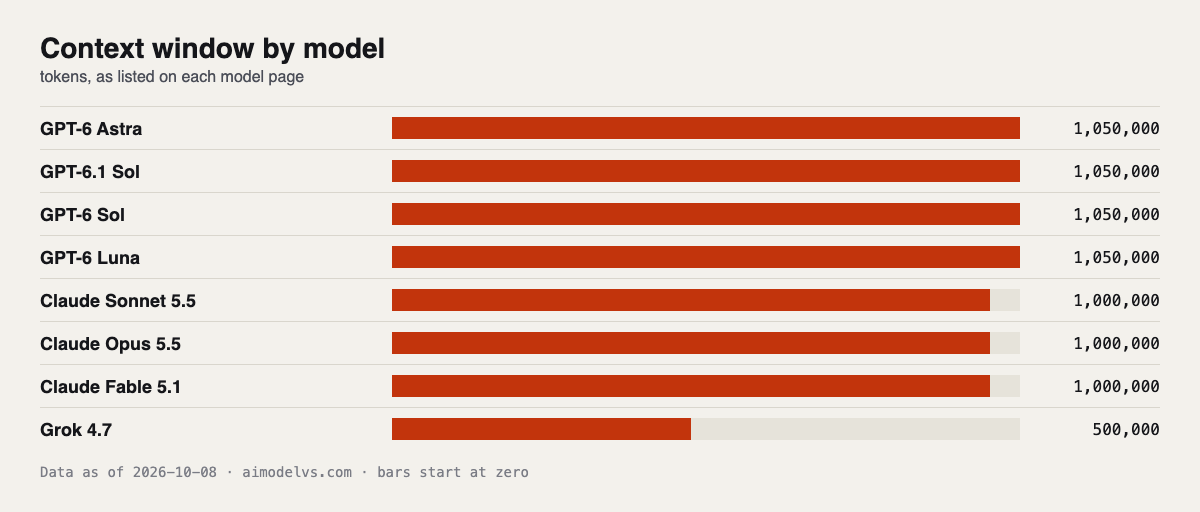
Use tokens when you need the real constraint. Context windows, rate limits and bills are all in tokens. GPT-6.1 Sol lists a context window of 1,050,000 tokens, and Grok 4.7 lists 500,000. At about 0.75 words per token, a window of one million tokens holds roughly 750,000 English words, which is a rough scale and not a guarantee.
Why AI is billed per token, and what a token costs
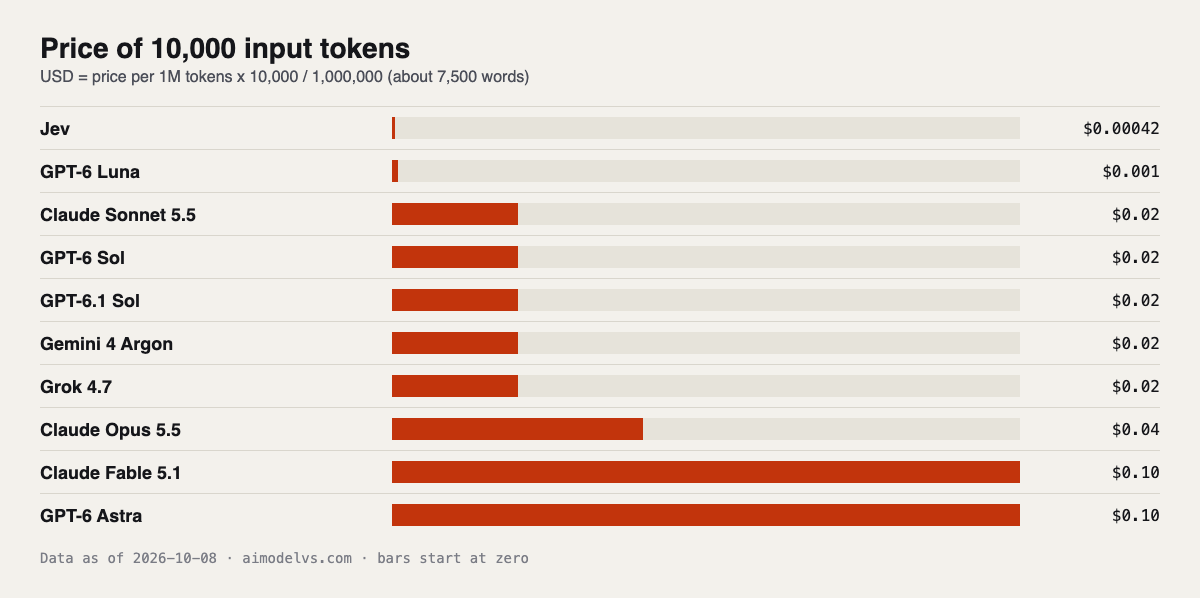
Tokens are the work the model does, so providers meter them. Input and output are priced separately, and output costs more than input on every model in our data that charges for output (one early-access model lists output as free). Prices are quoted per 1M tokens because one token is a tiny fraction of a cent. Three examples from this site's data: Claude Sonnet 5.5 lists $2.00 per 1M input tokens and $10.00 per 1M output tokens; GPT-6 Luna lists $0.10 and $0.50; GPT-6 Astra lists $10.00 and $50.00.
Turning those into the price of one token is a division by 1,000,000, and the price of 1,000 tokens is a division by 1,000. That arithmetic, with a table for every model, is on the page how much is a token in AI. For Claude models see Claude cost per token, and for every provider side by side see the AI token pricing comparison.
Two extra points. Reasoning models count their hidden thinking as output tokens, so a short answer can bill many output tokens. And some providers discount cached input or batch jobs; the rates are listed on each model page. To price an OpenAI workload with those options, use the OpenAI token cost calculator; to compare model families, see the Claude AI model comparison and the Open AI model comparison.
How to count tokens exactly
When the number matters, do not rely on an estimate. API responses report the input and output tokens that were actually billed, so the first real request gives you a true figure for your prompt. Some providers also offer a token-counting endpoint or an online tokenizer you can paste text into. Use one of those, with the model you plan to call, before you commit to a budget.
Charts: context windows and the price of 10,000 tokens
Frequently asked questions
What is an AI token?
An AI token is the unit of text a language model reads and writes. A tokenizer splits text into pieces such as whole short words, parts of longer words, numbers and punctuation, and the model works on those pieces. Providers also count and bill in tokens.
How many tokens is a word?
For ordinary English text a common rule of thumb is about 0.75 words per token, so one word is roughly 1.3 tokens. Short common words are often one token, while long, rare or technical words split into several. Code and non-English text usually use more tokens per word.
How many tokens is 1,000 characters?
Using the rule of thumb of about 4 characters per token, 1,000 characters of English is about 250 tokens. It is an estimate: the exact number depends on the model and the text.
Why are AI models billed by token?
Tokens are the unit the model actually processes, so the bill follows the work done. Prices are quoted per 1M tokens: Claude Sonnet 5.5 lists $2.00 per 1M input tokens and $10.00 per 1M output tokens, while GPT-6 Luna lists $0.10 and $0.50.
Do all AI models count tokens the same way?
No. Each model family uses its own tokenizer, so the same text can produce a different token count on different models. The estimator on this page is a rough guide. For an exact count use the provider's token counter or the usage figures returned by its API.
Sources
Prices and context windows come from the model data on this site, read from official provider pages on 2026-10-08; each model page lists its sources. The 4-characters and 0.75-word rules are common rules of thumb, described in the OpenAI help center. Models: Claude Fable 5.1, Claude Opus 5.5, Claude Sonnet 5.5, Gemini 4 Argon, GPT-6.1 Sol, GPT-6 Astra, GPT-6 Luna, GPT-6 Sol, Grok 4.7, Jev.