AI token pricing comparison: every model, price per 1M tokens
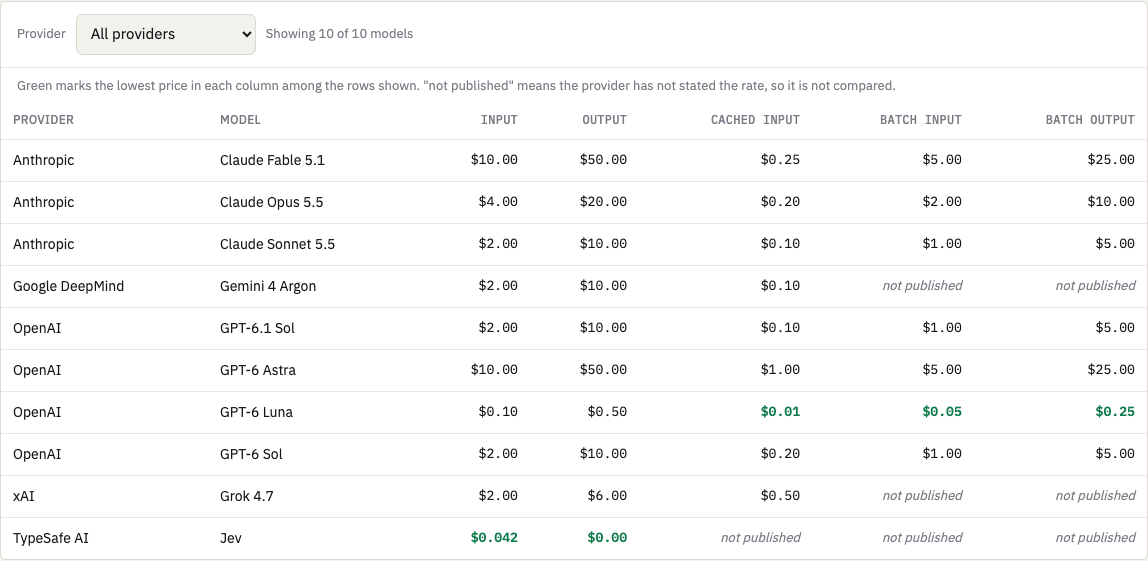
Use this AI token pricing comparison to see what each model charges per million tokens, side by side. The matrix below lists input, output, cached input and batch rates for 10 models from 5 providers. Click a column header to sort, pick a provider to filter, and read the lowest price in each column in green.
AI model price comparison: the full matrix
USD per 1M tokens · data as of 2026-10-08Green marks the lowest price in each column among the rows shown. "not published" means the provider has not stated the rate, so it is not compared.
| Anthropic | Claude Fable 5.1Anthropic | $10.00 | $50.00 | $0.25 | $5.00 | $25.00 |
| Anthropic | Claude Opus 5.5Anthropic | $4.00 | $20.00 | $0.20 | $2.00 | $10.00 |
| Anthropic | Claude Sonnet 5.5Anthropic | $2.00 | $10.00 | $0.10 | $1.00 | $5.00 |
| Google DeepMind | Gemini 4 ArgonGoogle DeepMind | $2.00 | $10.00 | $0.10 | not published | not published |
| OpenAI | GPT-6.1 SolOpenAI | $2.00 | $10.00 | $0.10 | $1.00 | $5.00 |
| OpenAI | GPT-6 AstraOpenAI | $10.00 | $50.00 | $1.00 | $5.00 | $25.00 |
| OpenAI | GPT-6 LunaOpenAI | $0.10 | $0.50 | $0.01 | $0.05 | $0.25 |
| OpenAI | GPT-6 SolOpenAI | $2.00 | $10.00 | $0.20 | $1.00 | $5.00 |
| xAI | Grok 4.7xAI | $2.00 | $6.00 | $0.50 | not published | not published |
| TypeSafe AI | JevTypeSafe AI | $0.042 | free | not published | not published | not published |
Every number comes from the model data files on this site, read from official provider pages on 2026-10-08. Cache write and fast-mode rates are on the model pages and are not in this matrix. For a monthly budget see the pricing calculator; for two models side by side see compare; all models are in the models table.
LLM cost comparison: what your tokens cost on each model
Enter how many millions of input and output tokens one job uses. The box prices that job on every model at list price, cheapest first, with no caching, batch or long-context rules applied. This is a quick comparison of one job; for a monthly budget ranked across all models, use the pricing calculator.
| Model | Input cost | Output cost | Total |
|---|---|---|---|
| Jev | $0.42 | $0.00 | $0.42 |
| GPT-6 Luna | $1.00 | $1.00 | $2.00 |
| Grok 4.7 | $20.00 | $12.00 | $32.00 |
| Claude Sonnet 5.5 | $20.00 | $20.00 | $40.00 |
| Gemini 4 Argon | $20.00 | $20.00 | $40.00 |
| GPT-6.1 Sol | $20.00 | $20.00 | $40.00 |
| GPT-6 Sol | $20.00 | $20.00 | $40.00 |
| Claude Opus 5.5 | $40.00 | $40.00 | $80.00 |
| Claude Fable 5.1 | $100.00 | $100.00 | $200.00 |
| GPT-6 Astra | $100.00 | $100.00 | $200.00 |
LLM price comparison: how to read the columns
Input is the price of the tokens you send: your prompt, instructions, documents and earlier conversation. Output is the price of the tokens the model writes back. Cached input is the lower rate some providers charge when part of your prompt was stored and is read again; it is a different rate from the normal input price. Batch prices apply to jobs you submit to run later, and Gemini 4 Argon, Grok 4.7 and Jev have no published batch rate in our data.
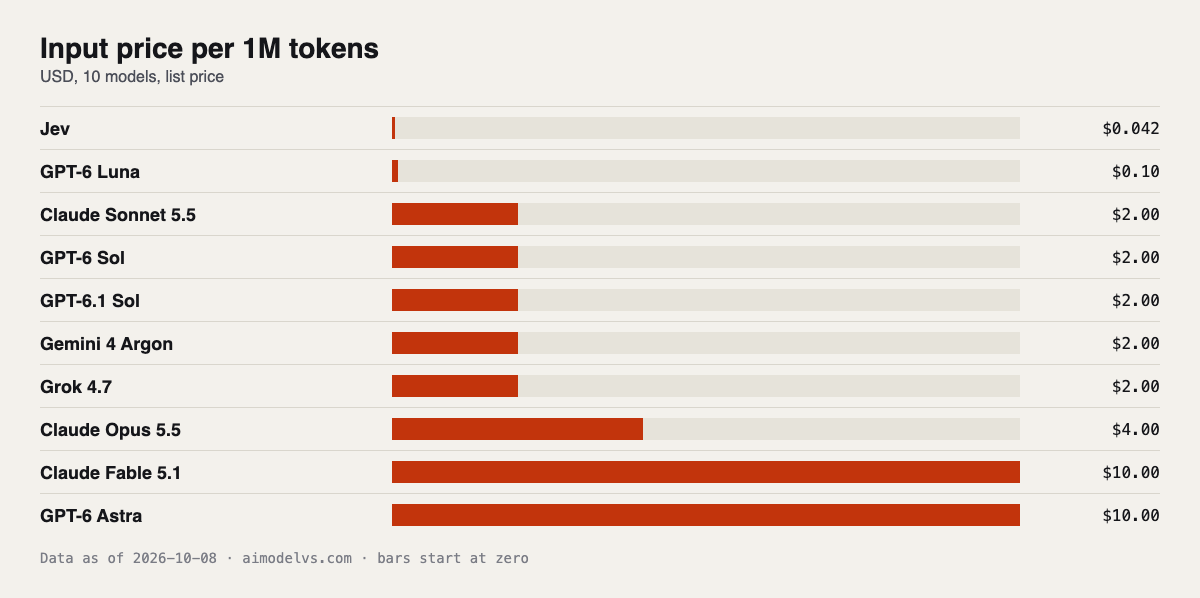
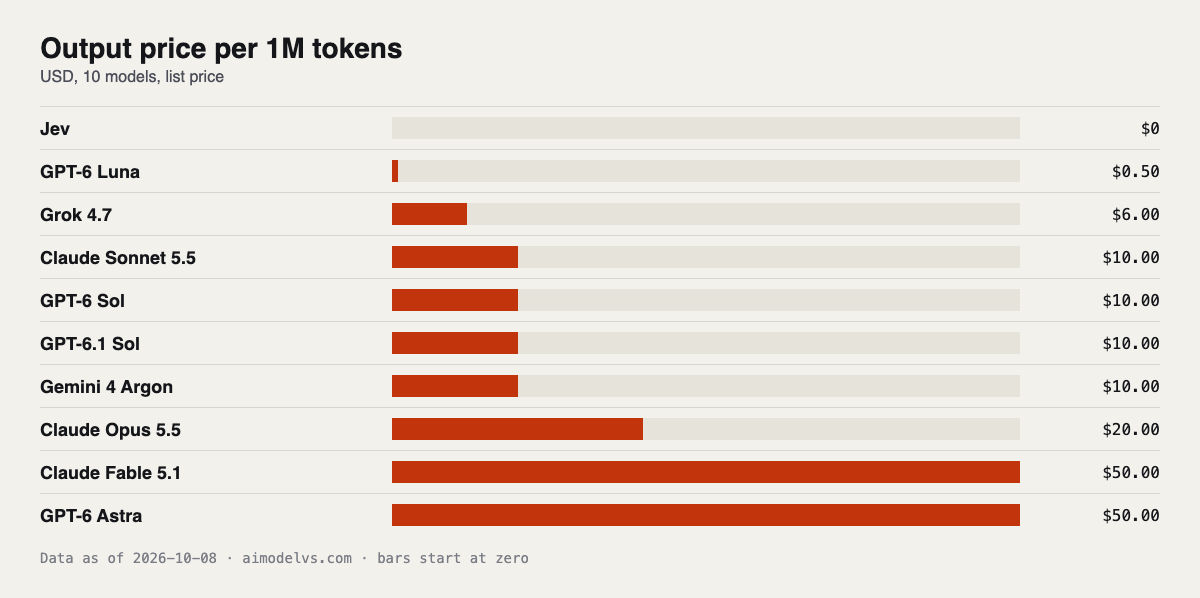
The spread is wide. Input runs from $0.042 (Jev) to $10.00 (Claude Fable 5.1 and GPT-6 Astra). Output runs from free on Jev, through $0.50 on GPT-6 Luna, up to $50.00 on Claude Fable 5.1 and GPT-6 Astra. Between the cheapest paid output rate and the dearest one, that is a 100x gap.
The ratios inside one model matter too. Claude Fable 5.1 lists cached input at $0.25 against $10.00 for normal input, and its data notes say cache reads are 2.5% of the input price. Claude Opus 5.5 lists $0.20 against $4.00. Batch input for Claude Opus 5.5 is $2.00, and batch output is $10.00, which is half of its standard output rate of $20.00.
Jev has no cached input rate published, and that cell stays empty rather than being filled in. A missing price is never treated as zero in the green highlight.
Cost per token: divide the price by one million
To get cost per token, divide the price per 1M tokens by 1,000,000. For Claude Opus 5.5, $4.00 per 1M input tokens is $0.000004 for one input token, and $20.00 per 1M output tokens is $0.00002 for one output token. The page how much is a token in AI turns this into a calculator, and the page Claude cost per token does it for the Claude models.
Charts: AI token pricing at a glance
Both charts are drawn from the matrix above.
AI token pricing: caveats recorded in our data
List price per token is not always the price you pay. Our data files record these caveats, quoted below from each model's notes. Long-context rules are noted for GPT-6.1 Sol, GPT-6 Astra, GPT-6 Luna, GPT-6 Sol and Grok 4.7. Fast or priority rates exist for Claude Opus 5.5, GPT-6.1 Sol, GPT-6 Astra, GPT-6 Luna, GPT-6 Sol and Grok 4.7; they are not in the matrix.
Claude Fable 5.1
- Cache read is 2.5% of input price (0.025x), the lowest ratio in Anthropic's lineup.
- 1-hour cache write is $20 / MTok.
- No fast mode listed for Fable 5.1.
- Full 1M context at standard price.
Claude Opus 5.5
- Cache read is 5% of input price (0.05x).
- 1-hour cache write is $8 / MTok.
- Fast mode (research preview, Claude API only) is $8 / $40.
- Full 1M context at standard price; no long-context surcharge.
Claude Sonnet 5.5
- Cache read is 5% of input price (0.05x).
- 1-hour cache write is $4 / MTok.
- Same list price as Sonnet 5.
- Full 1M context at standard price.
Gemini 4 Argon
- Introductory price $2 / $10; Google says $4 / $20 will apply after the introductory period. No end date published.
- Cached input: 95% off the input price.
- Batch, Flex, priority and grounding prices not published.
- Not listed on ai.google.dev pricing as of October 8, 2026.
- Standard price after the introductory period: $4.00 input / $20.00 output per 1M tokens.
GPT-6.1 Sol
- Long context (>272K input): 2x input and cache rates, 1.5x output ($4 / $15).
- Batch and Flex are 50% of Standard; Fast mode is 2x.
- Ultrafast tier announced for Astra first; no published Sol 6.1 Ultrafast price as of October 8, 2026.
- Regional processing adds a 10% premium where available.
GPT-6 Astra
- Long context (>272K input): $20 input, $75 output.
- Ultrafast tier: $60 input, $6 cached, $300 output (service_tier: ultrafast).
- Batch and Flex are 50% of Standard; Fast mode is 2x.
- Does not support the none reasoning effort level; no custom temperature or top_p.
GPT-6 Luna
- Long context (>272K input): 2x input and cache rates, 1.5x output.
- Batch and Flex are 50% of Standard; Fast mode is 2x.
- Regional processing adds a 10% premium where available.
GPT-6 Sol
- Long context (>272K input): 2x input and cache rates, 1.5x output.
- Batch and Flex are 50% of Standard; Fast mode is 2x.
Grok 4.7
- Long context (>=200K prompt tokens): $4 input, $1 cached input, $12 output, applied to every token in the request.
- Fast variant: twice the output speed at twice the token price (1.5x for long-context requests); xAI says it is available only in Cursor and Grok Build, not on the public API.
- Batch API is not supported for this model as of October 8, 2026.
- Server-side tools (web search, X search) are billed per call on top of tokens.
Jev
- Output is listed as free ('too cheap to meter').
- TypeSafe's FAQ asks whether prices are temporary or subsidized without answering.
- Early-access pricing; verify in the console before budgeting.
Frequently asked questions
What is AI token pricing?
AI providers bill API use by the token, the small chunk of text a model reads or writes. Prices are quoted in US dollars per 1 million tokens, with one rate for input tokens (what you send) and a separate rate for output tokens (what the model writes). Some providers add rates for cached input and batch jobs.
Which model has the lowest price per token in this comparison?
Jev has the lowest input price at $0.042 per 1M tokens, and its output is listed as free. Among models with a paid output rate, GPT-6 Luna has the lowest output price at $0.50 per 1M tokens. Prices are as of 2026-10-08.
Why do output tokens cost more than input tokens?
In this data, output is priced above input for every model except Jev. Providers set the two rates separately. Reasoning models also count their thinking as output, so output volume often decides the bill.
How is this different from the pricing calculator and the compare pages?
The pricing calculator ranks every model by monthly cost for a monthly volume. The compare pages put two models side by side. This page is the full price matrix, with every rate for every model in one table, plus a quick cost box for one request size.
Are these prices current?
They are the list prices we read from each provider's official page, with the data dated 2026-10-08. Providers change prices, so confirm on the linked source page before you budget.
Sources
Each model's sources, with the date we read them, are on its page: Claude Fable 5.1, Claude Opus 5.5, Claude Sonnet 5.5, Gemini 4 Argon, GPT-6.1 Sol, GPT-6 Astra, GPT-6 Luna, GPT-6 Sol, Grok 4.7, Jev. This site is independent and unofficial.